whitefeatherhunter.ca
*website under perpetual construction - best viewed on a desktop browser
ALMA, 2009 - ongoing*
ALMA is a rogue taxidermy sculpture that interrogates the cultural construction of female autonomy, hybridity, and sexuality through processes of worship, demonization, and myth-making. Composed of human hair, animal remains, and found materials, the figure exists as a speculative body assembled from fragments of the human and more-than-human. Initially encountered in gallery settings, ALMA later exploded into digital culture notoriety, where it circulated widely and unpredictably. The work went viral in 2012, generating over 6 million views within days, hitting the top front page post on reddit, and re-emerged in 2015 through renewed circulation. During this process, online audiences collectively named the figure “Hoof Hand,” transforming it into a distributed, participatory identity.
ALMA operates across physical and networked contexts, exemplifying how bodies become culturally animated through circulation, projection, and collective authorship.
Materials: Human hair, found wig, recycled Persian lamb coat, beaver fur, rabbit fur, mink fur, raffia, goat skin, acrylic paint, gold leaf, beeswax, deer hoof, moose teeth, taxidermy epoxy putty, found vintage mannequin
Dimensions: 69 x 33 x 24 inches (and web-based iterations)

Human hair, Persian lamb, beaver fur, rabbit fur, mink, raffia, goat skin, acrylic paint, gold leaf, beeswax, deer hoof, moose teeth, taxidermy epoxy, found vintage mannequin. 69” x 33” x 24”


James West photo for the Daily Gleaner


Human hair, Persian lamb, beaver fur, rabbit fur, mink, raffia, goat skin, acrylic paint, gold leaf, beeswax, deer hoof, moose teeth, taxidermy epoxy, found vintage mannequin. 69” x 33” x 24”

Human hair, Persian lamb, beaver fur, rabbit fur, mink, raffia, goat skin, acrylic paint, gold leaf, beeswax, deer hoof, moose teeth, taxidermy epoxy, found vintage mannequin. 69” x 33” x 24”
THE OSSIFICATORIUM, 2013-2014
The Ossificatorium marks a key transition in my practice from material-based investigations of the body toward bioart and systems-based work. Combining textile, chemical, and tissue-based sculpture with narrative, digital media, and public intervention, the project spans physical and virtual environments. Objects are encountered as biomimetic artifacts, exhibited in galleries, dispersed in public space, and tracked online, accompanied by speculative osteobiographical texts that situate them within a parallel system of knowledge.
This work establishes an expanded framework for understanding the body as a distributed, narrative, and technologically mediated process.
View The Ossificatorium project website here.
This project was generously supported with funding from Concordia University, the Social Sciences and Humanities Research Council of Canada, and Hexagram | CIAM.

Image featured in all PR to represent Concordia's MFA program, 2013.

Magnesium sulfate crystals grown on knit hog gut

laser-etched (with textile patterning) sheet acrylic, magnesium sulfate crystals grown on knit hog gut, deer teeth, gel wax

Interior detail with DIY GPS unit in hand-dyed silk pouch

In situ/ abandonment, Musée des beaux arts, Montreal

Live online GPS track of object in motion after abandonment
PARENT FOLDER, 2012-2013
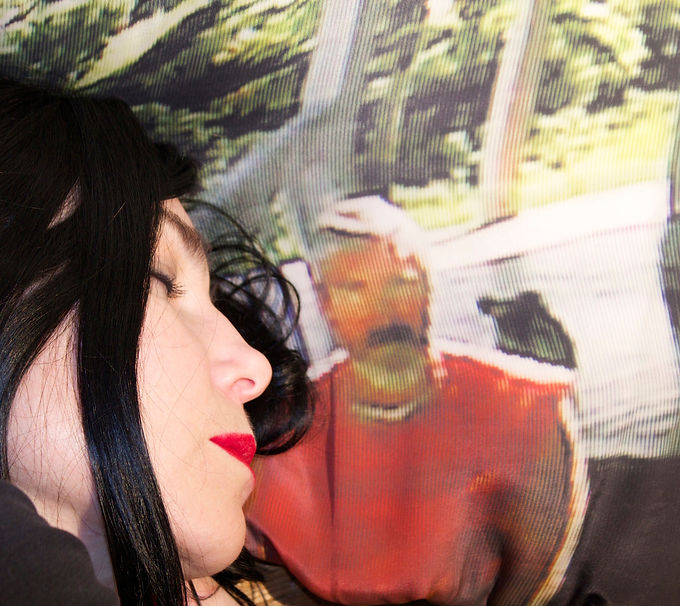
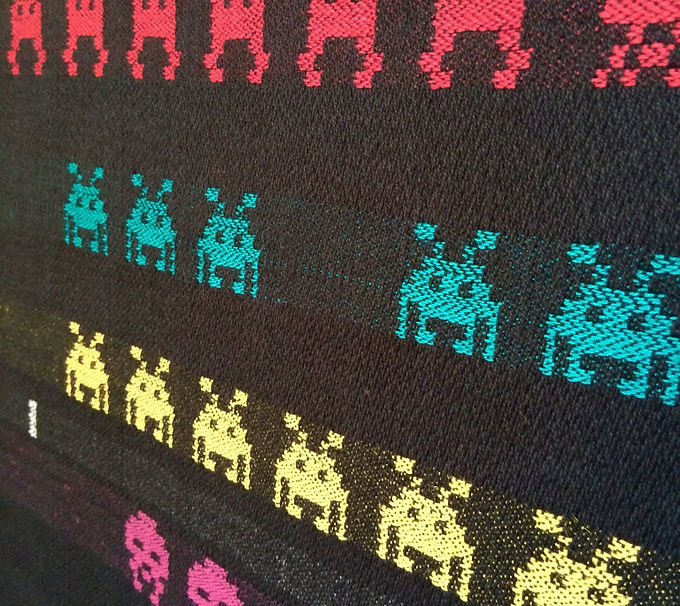
The entire Parent Folder project includes stop motion animation digital video [11:59 minutes] of collected surveillance footage over a 12-month period (with subtitled text excerpts), a daily 12-month surveillance log, as well as a digitally printed silk body pillow that the artist performed sleeping with every night for one year (displayed as performance artefact). See the body pillow here. A number of Jacquard weavings were produced of some of the surveillance images as well, here.
Psychogeography is the "study of the laws of geographical space on the emotions and behaviour of individuals"(1). Described as "passional terrain"(2) by Guy Debord, psychogeography embodies the discovery of the elements and meaning of 'place'. 'Digital psychogeography' could describe the phenomenon of parallel existence of plane: on earth, and its simultaneous spatial representation in cyberspace, twinning place and "no-place".
The Parent Folder project stems from an interest in these considerations and how they have been considered aesthetically in an age of increasing digital intervention. In 2012, my distant father gave me online passcode access to his property surveillance camera so that I was able to pan the landscape and become a voyeur of his daily life. I downloaded material from an encoded archive called the Parent Folder, and used it to create objects that responded to my experience of watching him. In computing, the terms "parent" and "child" are often used to describe the hierarchical relationship between a directory and its sub-directory.
Parent Folder applies principles David Lyon has described when referring to surveillance, in terms of technologies that mediate relationships that are not co-present, as well as surveillance as a replacement for "tokens of trust" where the body has disappeared from interactions (3). The twinned worlds in Parent Folder form an interface through which affective bonds are fostered without face-to-face interaction.
1. Debord, Guy. Introduction to a Critique of Urban Geography (1955) in Situationist International anthology, trans. Knabb, Ken. 1981. Berkeley, Calif: Bureau of Public Secrets, 8-12.
2. Debord, Guy. Theory of the Dérive (1958) in Situationist International anthology, trans. Knabb, Ken. 1981. Berkeley, Calif: Bureau of Public Secrets, 62-67.
3. Lyon, David. “Everyday surveillance: personal data and social classifications” in The Surveillance Studies Reader (Hier, Sean P. and Josh Greenberg, eds.). England: Open University Press. 2007. pp. 136-7.
The work was presented as a work in progress as part of the group exhibition, Cyber In Securities curated by Lisa Moren at the Pepco Edison Place Gallery in Washington, DC as well as part of a group video installation curated by Terrance Houle and presented at The Works Art & Design Festival in Edmonton, Alberta as well as at Galerie Sans Nom in Moncton, New Brunswick. It was also shown as a work in progress in a solo exhibition at Mouse Print Gallery (Concordia University Print Media Department) and at Art Mûr (Montreal). It's final (full-year archive) was presented at Studio XX (Montreal) as part of the 2016 HTMlles Festival.

Private online surveillance image digitally printed onto silk, sewn into a pillow, performed (sleeping with) nightly for one year, for the duration of the total project entitled, Parent Folder. The performative aspect of the project attempts to make physical the nonphysical, in search of intimacy mediated through web-based platforms.


Art Mûr, Montreal

Pepco Edison Place, Washington, DC

Studio XX, Montreal. Photo credit: Lien Multimédia.

Digitally printed silk sewn into pillow and used for one-year durational performance.
SQUIRRELY, 2011
[2:09] minutes
Appropriated YouTube video footage of two separate videos, edited and spliced, with captions added.
Squirrely examines two modes of social treatment of the squirrel body. Both original YouTube videos provoked similar social hysteria online, in comments sections, despite the difference of rites.

Video still

Video still

Video still

Video still

Back projection installation on fabric, Dooryard Arts Festival, Woodstock, NB

Back projection installation on fabric, Dooryard Arts Festival, Woodstock, NB. Shown installed with Ossa phototextile.
FANTASMAGORIE, 2011
[4:53] digital video/ one-night rear-projection installation
Drawing on the concept of phantasmagoria or the magic lantern, a late 18th-century French theatre technique, fantasmagorie was presented as part of A Surreal Masquerade at the Beaverbrook Provincial Art Gallery, New Brunswick.
Images link to the video.
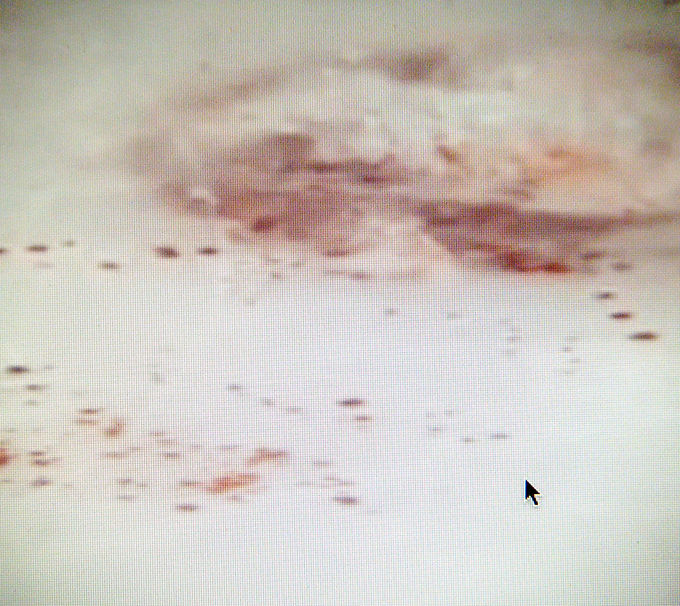
Skype-mediated performances by both a professional and non-professional performer are choreographed by the artist. This work connects the technology of a computer screen projection with the idea of the magic lantern, in a sequence of lo-fi surreal images. Flaws/ features of the medium are exploited, including internet lag, two-pass interlacing jaggies, pixelation distortion and cursor arrow.

Performed by Brit Hunter

Installation at the Beaverbrook Provincial Art Gallery, Fredericton, NB


Installation at the Beaverbrook Provincial Art Gallery, Fredericton, NB

Performed by Shantell Powell

Rear projection room, Beaverbrook Provincial Art Gallery, Fredericton, NB