the witch in the lab coat
Best viewed on a desktop browser for an infinitely better visual experience.
whitefeatherhunter.ca

THE BACTINCTORIUM


2017-2018
The Bactinctorium was a collaborative research-creation project developed by WhiteFeather Hunter, Alexandra Bachmayer, Geneviève Moisan, and Vanessa Mardirossian, investigating pigment-producing bacteria as sources of colour for textiles and other materials, one of the first microbial textile dye projects of its kind.
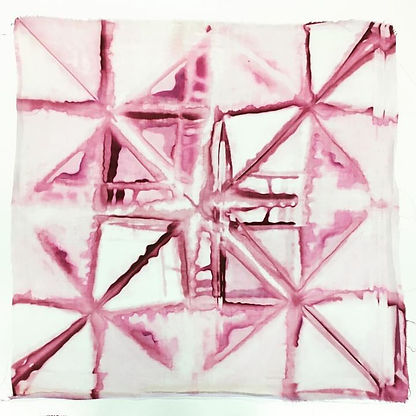
Leading up to, and as part of this research, WhiteFeather developed several experimental techniques that translated textile expertise into microbiological systems. One such method, Petri Dish Shibori, adapted the resist-dyeing principles of Japanese shibori to bacterial culture. Rather than manipulating pigment directly on cloth, bacterial growth patterns were shaped through folds, barriers, and spatial interventions within petri dishes, producing complex living designs generated through the interaction of textile structure and microbial behaviour.
Taking a feminist approach to bioart and biotechnology, the team developed a novel menstrual blood agar protocol for culturing iron-dependent bacteria. Believed to be the first protocol of its kind, the medium was designed as an alternative to conventional blood agars while simultaneously challenging cultural assumptions surrounding menstrual material. By repositioning menstrual blood as a laboratory resource rather than biological waste, The Bactinctorium transformed questions of biosafety, bodily autonomy, and material agency into sites of artistic and scientific inquiry.
Another method the team explored was producing controlled bacterial imagery through the use of laser-cut stencils placed within culture plates. Pigment-producing bacteria were cultured over these stencils, creating precise microbial patterns that could subsequently be transferred onto textiles through printing processes. These techniques expanded the expressive possibilities of microbial dyeing while challenging conventional distinctions between laboratory practice and craft.
The project contributed to emerging conversations around sustainable colour production, living materials, and microbial agency, while advancing a broader technofeminist investigation into how biological systems might participate in acts of making. Research outcomes included bacteria-dyed textile samples, experimental protocols, workshops, lectures, and publications that helped establish microbial dyeing as a significant area of inquiry within contemporary bioart and biodesign. Beyond the laboratory, The Bactinctorium became a site of pedagogy and community-building. WhiteFeather taught numerous workshops on bacterial dyeing, microbial colour production, and DIY laboratory methods within the Speculative Life BioLab (Milieux Institute) and a master class at NSCAD University through IOTA Institute, as well as mentoring students and emerging artists interested in developing their own microbial practices. The project was supported by the Textiles and Materiality Research Cluster and more broadly the Milieux Institute for Arts, Culture and Technology at Concordia University.
Publications:
The work has been featured in the Material Futures issue of Centre for Sustainable Practices in the Arts (CSPA) Quarterly (WhiteFeather Hunter, guest editor), with WhiteFeather's work also featured in: MARCOLETA, Andrés, BARBET, André and BOCCARDO, Giorgio. 2021. “Experiencias previas de arte con microorganismos.” In: De cobre, microbios y arte. Santiago: Universidad de Chile, Facultad de Artes.
Also, in HUNTER, WhiteFeather. 2025. “Blood Acumen.” In: WASSIBAUER, Rüdiger and FÖRG, Bernhard (eds.), YnselBuch #6: Schmiede23 – Blut. Hallein, Austria: Schmiede / Akademie Hallein / YslandBook.
Also in HEY, Maya, HUNTER, WhiteFeather and ST. HILAIRE, Emilie. 2019. “Horizontal Exchange, Relations, and Resistance in Bioart and Practice-based Research.” Journal International de Bioéthique et d'Éthique des Sciences, 30(4):69-89. https://doi.org/10.3917/jib.304.0069
Also, in HUNTER, WhiteFeather. 2024. “The Phenomenology of Menstruation: (Bio)artworks Within the Feminist Occult.” Passepartout: Journal of Art Theory and History, 26(44):63-86, Special issue: Blod. https://tidsskrift.dk/passepartout/article/view/146198
Bactinctorium is featured in a forthcoming chapter in the Bloomsbury World Encyclopedia of Textiles: Textile Futures (WhiteFeather Hunter, author).